
How Screens Affect Mealtime and Nutrition in Kids: Tips for Mindful Eating Habits From a Pediatric Dietitian
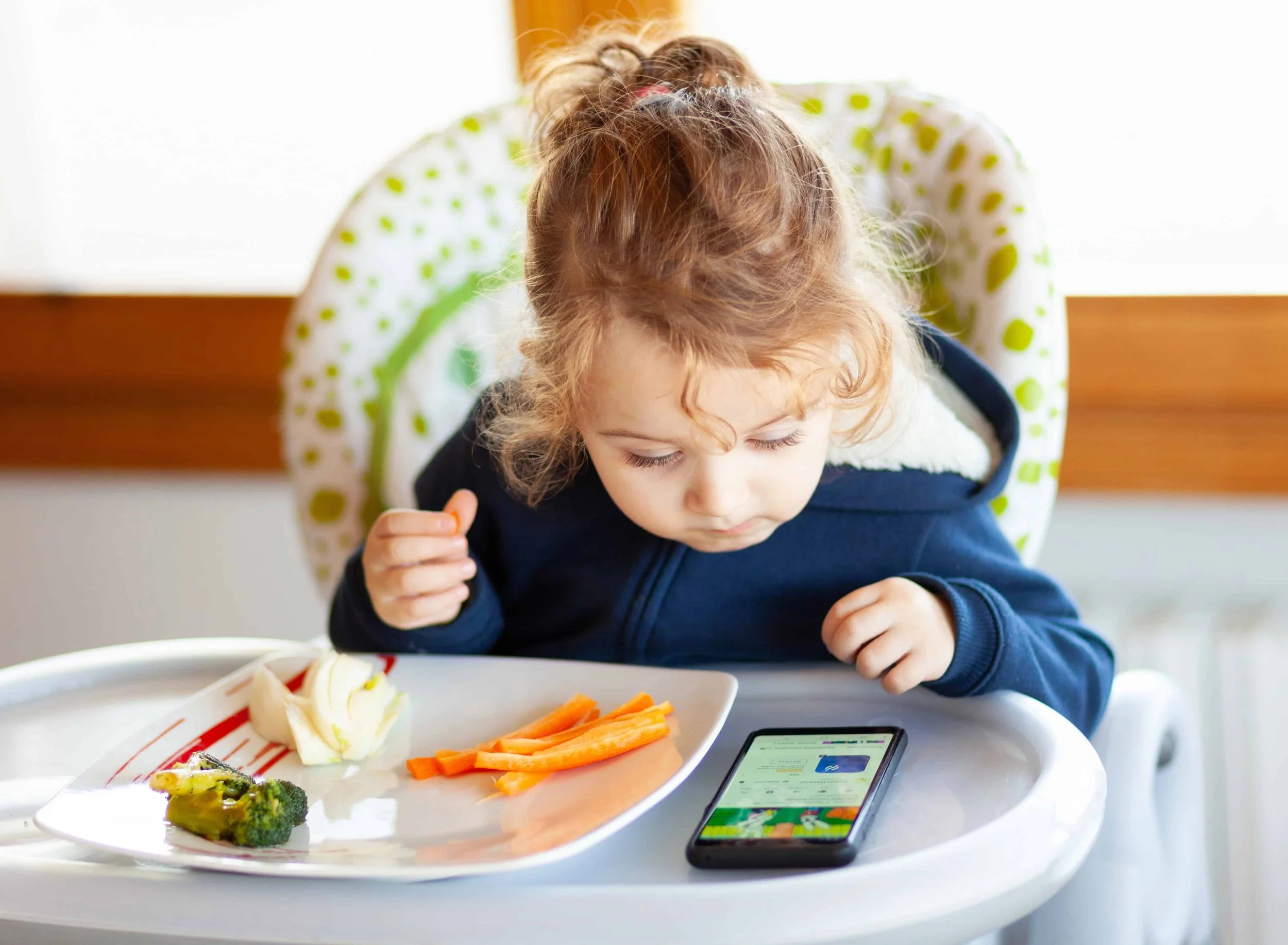
Dinner is on the table, the TV is on in the background, your toddler has finally stopped crying long enough to sit down, and you're just trying to get through the meal without a meltdown. Sound familiar? For most families I work with, screens and mealtimes have merged so gradually that it barely registered as a choice. It just... happened.
And before we dive into the rest of this article, I want to start by saying that this is completely understandable. Parenting is hard, kids can be exhausting, and sometimes a screen is the only thing standing between you and complete chaos! I’ve certainly been there, more times than I can count.
But there is emerging research that even parents who feel pretty neutral about mealtime screens should be aware of, because it has changed how I think about this topic, too.
In this post, I'll walk you through what the science actually says about screens, mealtime, and nutrition in kids, including some findings that surprised me, and I'll offer practical, low-pressure strategies that work for real family life. Because "just turn it off" is not always the realistic and doable answer.
What Screen Time Actually Does to Kids at the Table
The research picture is pretty consistent here. A 2022 study looking at Chilean children and adolescents found that 87.5% consumed at least one meal or snack while using screens daily. Higher TV viewing was associated with greater consumption of sweets, desserts, and sugar-sweetened beverages.
Another 2020 study found that an "informal meal setting" (including mealtime screen use, not sitting at a table, and not eating in a dining area) was associated with a significantly higher risk of obesity trajectories in children.
And the 2026 American Academy of Pediatrics technical report on digital ecosystems confirmed that decades of observational research link screen time duration with higher adiposity and unhealthy weight gain in children and adolescents, with mechanisms including greater energy intake, exposure to food marketing, and eating during media use.
There is also the food-marketing angle, often overlooked. Children watching TV during meals are repeatedly exposed to advertising that heavily favors ultra-processed, high-sugar, and high-fat products. Over time, that exposure quietly shapes what kids consider normal and desirable food. It doesn't happen all at once, but it adds up.
It's worth noting that most of this research is observational, which means it shows associations, not proof that screens cause worse eating. What the research does show is a consistent, cross-cultural pattern that's hard to dismiss, and for many families, that's enough to warrant attention.
The Hunger Cue Problem
Young children are actually remarkably well-calibrated eaters when they're fully present. Babies and toddlers come with genuine hunger and fullness signals that, when respected, support healthy intake regulation. This built-in, self-regulation system is one of the most valuable tools in a child's nutritional toolkit.
Screens interfere with it in a pretty direct way. When a child is absorbed in a show or game, their brain is so engaged elsewhere that the quieter signals of fullness simply don't register. They keep eating because the food is there and their hands are moving, not because their bodies are asking for more. This is sometimes called "mindless eating," and the AAP has specifically flagged it as one of the key reasons to establish screen-free time at meals.
Over time, children who regularly eat with screens may become less able to tune in to their own hunger and satiety cues. This pattern, once established, can follow kids into adolescence and adulthood. Catching it early, or at least being aware of it, genuinely matters.
"But It's Just Background TV."
This is one of the most common things I hear from parents, and honestly, it makes total sense as a mindset. If nobody is actively watching the TV, surely it doesn't count? The problem is that research doesn't really back that up, and it's one of the more surprising nuances in this whole conversation.
A 2024 study found that toddlers whose TV was "usually on" during mealtimes were significantly more likely to consume sugar-sweetened beverages (3.7 times more likely), fast food (2.8 times more likely), and junk food overall (4.25 times more likely) compared to toddlers whose TV was off at meals.
The ambient presence of screens during meals creates a low-level distraction that affects the whole mealtime environment, not just the child most obviously glued to a device. The meal becomes background noise, too, and that shift in the environment is enough to change what does (and doesn’t) get eaten.
A Note on Real-World Feeding (Because Nuance Matters Here)
I want to pause here and be honest about something that's important: screens at mealtimes are not always the enemy! For some families and some kids, a screen can be the difference between a child eating and a child refusing to eat altogether.
For kids with sensory sensitivities, feeding difficulties, picky eating, or significant food anxiety, a familiar show playing in the background can sometimes help reduce the stress of a meal enough to make eating possible. That is not a failure. That is a tool.
The research tells us about averages and population-level trends. It doesn't tell us about your specific child, your specific evening, or the particular brand of chaos that is Tuesday dinner in your house.
For families navigating picky eating or feeding difficulties, this whole conversation can look different, and it may be helpful to work with a pediatric dietitian or feeding specialist to figure out what a thoughtful, gradual path forward actually looks like for your kid.
What the research does tell us is that making screens the default for every meal, every day, carries real risks worth being aware of. And that even small, intentional shifts can make a difference. The goal isn't perfection. It's awareness and intention, applied wherever you actually have bandwidth for it.
Why Nutrition Education for Children Starts at the Table
One of the things I love most about family meals is how much learning happens without anyone trying. Not in a formal, lesson-plan kind of way, but in the quiet, cumulative way that the most meaningful lessons tend to work.
The research on family meals is genuinely encouraging. Children who regularly eat with their families have better overall diet quality, consuming more fruits, vegetables, and nutrients than children who eat alone or with the TV on.
When children eat with present, engaged adults, they pick up on things: how we talk about food, how we describe flavors, and whether we approach eating with enjoyment or stress. They absorb what a varied meal looks like. They learn the social rhythms of eating, which are tied to culture, identity, and connection in ways that go far beyond nutrition.
Nutrition education for children doesn't come from lectures about vegetables. It comes from sitting at the table and taking in what eating looks like in their family. Screen-free meals, even occasional ones, create space for that kind of learning. And that learning compounds over the years in ways that are hard to measure but very real.
Mindful Eating for Children: What It Actually Looks Like
I know "mindful eating" can sound abstract, or like something that requires more bandwidth than most parents have on a weeknight. For kids, it really just means being present with their food, and it's more approachable than it sounds.
One of my favorite low-effort techniques is what I call the "describe it" game. Before eating, ask your child to tell you one thing they notice about what's on their plate: the color, the smell, or whether it looks crunchy or soft. This takes about ten seconds, costs nothing, and gets their attention on the food instead of elsewhere. It also opens up conversation in a way that feels natural rather than forced.
If screens have typically been present for you as a family, and you’re trying to move away from that habit, a gentle strategy that can help is to start by removing the background TV first. Even if you're not ready to go fully screen-free, turning off ambient TV that nobody is actively watching is a low-effort first step with real impact, given what we know about background screens and mealtime eating patterns.
Finally, giving kids some small stake in the meal, whether that's stirring something, picking which vegetable goes on their plate, or setting the table, increases their engagement with the meal itself.
Children who feel a sense of ownership over what they're eating are more likely to actually be present with and invested in it. These aren't magic fixes, but practiced consistently, they build the habit of mindful eating for children in a way that lasts.
Practical Strategies to Reduce Screens at Mealtimes
If screens at the table are deeply embedded in your family's routine, going cold turkey is probably not the move. All-or-nothing approaches tend to create conflict and backlash, especially with kids. The goal is gradual, sustainable changes that your family can actually stick with.
As a pediatric dietitian and mom of three girls, here are a few of my top tips:
Start by designating one meal a day as screen-free, usually whichever one is most realistic for your schedule. Frame it as a family experiment rather than a new rule. "Let's try eating together without TV tonight and see what happens" lands very differently than a prohibition.
Create a practical landing spot for devices. A basket, a charger on the counter, anywhere that isn't the table. When phones and tablets have a designated home during meals, the habit of leaving them there becomes automatic over time.
Turn off the background TV, even if you're not ready to address phones or tablets yet. As research on toddlers shows, ambient screens pose risks independent of whether anyone is actively watching. This is one of the most impactful changes you can make with the least friction.
And if your child uses a screen to get through meals because they're a picky eater or dealing with feeding difficulties, that's a different, more nuanced conversation, and one worth having with a pediatric dietitian or feeding specialist. Removing screens in that context may need to be done carefully and strategically over time.
The most important principle: every small step counts. One meal a week without background TV is a start!
In Conclusion…
If your family eats with screens most of the time right now, that doesn't mean you're failing. It means you're navigating real life, and real life is hard. But I do believe that screen-free mealtimes, even occasional ones, are one of the most underrated investments you can make in your child's long-term relationship with food. The research backs that up.
If your child is struggling with picky eating, check out my FREE guide to reducing picky eating, or if you are looking for more guidance navigating picky eating behaviors in your toddlers, preschoolers, and school-age kiddos, check out my online course, Solve Picky Eating, a self-paced set of 12 modules that are delivered quickly in 5-15 minute videos.
If you'd like support on building healthier mealtime habits for your family, I'd love to help. I am currently accepting new clients in my virtual private practice. Book a 1:1 session with me, and we’ll get to the bottom of it.
Thanks for reading!