
When You Can't Keep Your Prenatal Down: A Dietitian's Take on Prenatal Nausea and Vitamins
Disclosure: This post is sponsored by Needed, a brand I recommend to my patients and use personally. This information is for educational purposes only and is not intended to replace individualized medical advice. Always talk with your healthcare provider about your specific nutrition and supplement needs during pregnancy.

Some mornings in pregnancy, the prenatal vitamin sitting on the kitchen counter feels like a very unreasonable request.
You might be able to tolerate a few crackers or a piece of toast, but the thought of swallowing a large capsule (let alone more than one) is enough to turn your stomach. To complicate things further, you might even sometimes manage to take your prenatal only to lose it twenty minutes later.
This was certainly the case for me (pictured here at 34 weeks pregnant with my first baby). I had horrible morning sickness throughout all three of my pregnancies, so I know this feeling well.
It’s especially hard when you are also chasing toddlers, trying to get everyone fed and dressed, and somehow trying to remember to take care of yourself and your growing baby in the middle of it all.
If you have quietly stopped taking your prenatal because you can't tolerate it, I want you to know that this is common. It isn't a character flaw, and "just take it" isn't particularly helpful advice when taking it actually makes you feel worse.
And if you are pregnant again while still breastfeeding or not long after a previous pregnancy, the conversation around nutrient needs can feel even more important.
However, the practical side matters, too. In fact, that’s why I wrote this article. Three gummies that you can actually chew and swallow are much more useful to a pregnant mom than three capsules sitting untouched on the counter at the end of the day.
In this post, I’m breaking down why prenatal vitamins can be so hard to tolerate during pregnancy, what to know about vitamin B6 and pregnancy nausea, and how to choose a prenatal gummy if capsules just aren’t working for you.
Why Nausea Makes Prenatal Vitamins So Hard to Take
Pregnancy nausea can make almost everything about taking a prenatal vitamin more difficult. Smells may suddenly feel overwhelming. An empty stomach can make it feel worse, but eating enough to be able to take a supplement can feel impossible. And then there is the prenatal itself, which, if providing an adequate amount of key pregnancy nutrients, usually requires taking more than one capsule.
Iron can contribute to this problem, too. Although iron is an important nutrient during pregnancy, taking iron as a supplement can cause gastrointestinal side effects for some people, including occasional nausea and constipation.
It can be frustrating when the time you most want to be consistent with your prenatal is also when your body is least interested in cooperating. That’s partly why I think of adherence as a nutrition variable, not a willpower issue.
A prenatal vitamin in capsule form with an impressive nutrition label doesn't provide much benefit if you can't swallow it or can't keep it down. Sometimes switching to a different form, like a gummy, is a very reasonable first step to better adherence, as long as that gummy prenatal is carefully formulated to provide key nutrients in adequate amounts.
What We Know About Vitamin B6 and Pregnancy Nausea
Vitamin B6, also called pyridoxine, is an interesting nutrient when we're talking about pregnancy nausea because it plays two different roles in this conversation.
First, vitamin B6 is an essential nutrient with a recommended intake of 1.9 mg per day during pregnancy. Second, the American College of Obstetricians and Gynecologists (ACOG) recommends vitamin B6 supplementation for nausea and vomiting during pregnancy.
Taking a prenatal with B6 is not the same thing as taking vitamin B6 specifically for morning sickness. The doses studied for helping to soothe occasional nausea are considerably higher than the recommended daily intake during pregnancy.
The recommended dose for helping to relieve occasional nausea is 10 to 25 mg every eight hours, with an upper limit of 100 mg per day. Most prenatal supplements do include vitamin B6, but the median amount is only about 5 mg per serving.
IMPORTANT NOTE: If you are pregnant and having persistent vomiting, losing weight, becoming dehydrated, or struggling to keep fluids down, please reach out to your healthcare provider ASAP.
The Trade-Off Built Into Most Gummy Prenatal Vitamins
Gummies have one very obvious advantage: for many people, they are easier to take.
But there is a reason you don't see every vitamin and mineral packed into a tiny handful of gummies. There is a limit on how much nutrition you can pack into a gummy while keeping it reasonably sized, chewable, and palatable.
Historically, that has meant a trade-off. Prenatal gummies have often been easier to tolerate but less nutritionally complete than many prenatal capsules.
Fortunately, newer prenatal gummies can deliver more substantial amounts of nutrients that are important during pregnancy, including vitamin D, B6, and folate, without requiring you to swallow multiple large capsules. For someone who is dealing with prenatal nausea, this can make such a big difference!
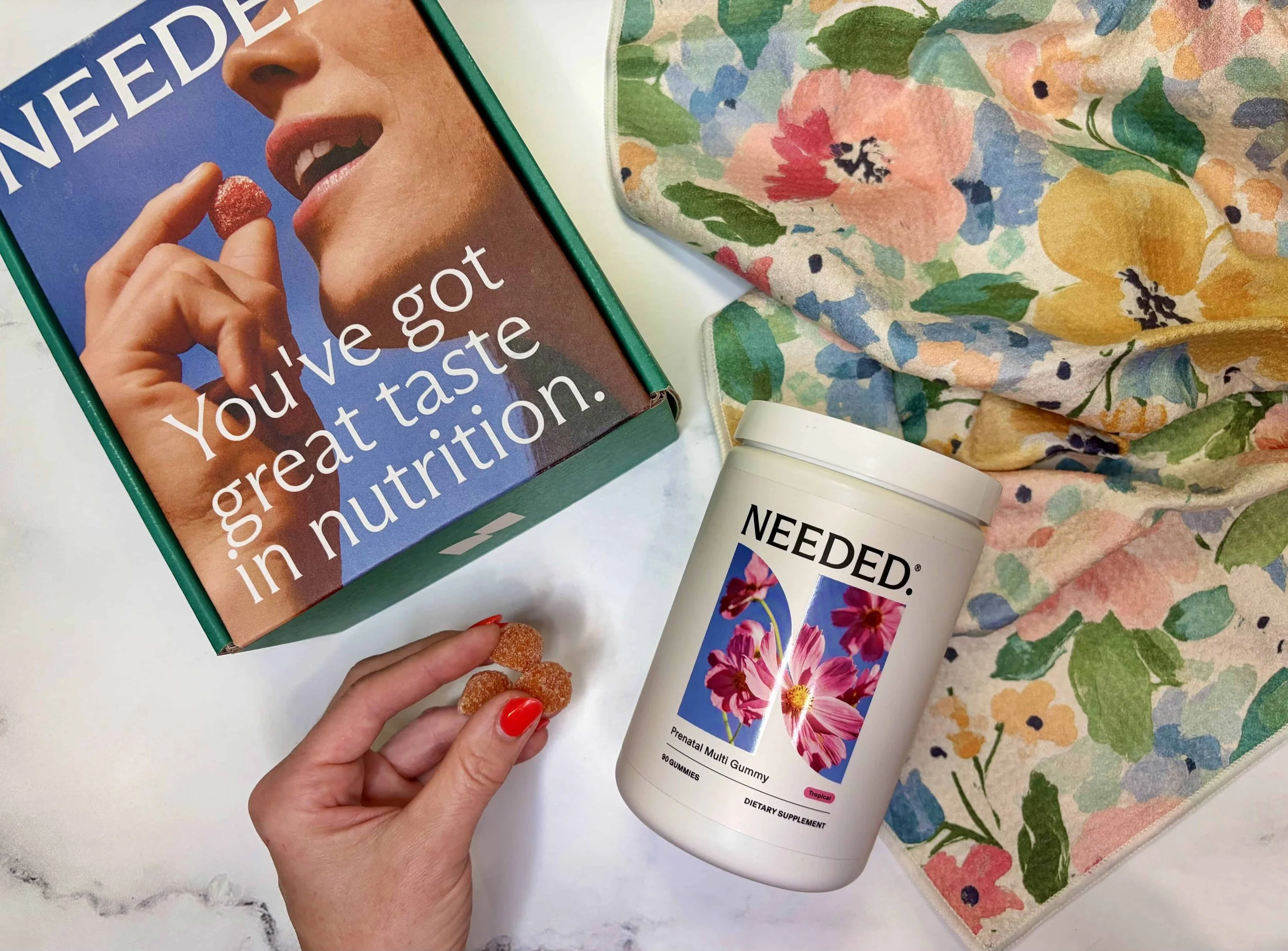
That’s one of the reasons I was excited to partner with Needed on this post. Their Prenatal Multivitamin Gummy is easy to take, delicious (I find both the Strawberry Banana and Orange Passionfruit Pineapple flavors truly pleasant), and packed with meaningful amounts of many of the nutrients I look for in a prenatal vitamin.
In fact, Needed’s Prenatal Multi Gummy provides 8x more nutrition than the leading prenatal gummy ǁ and 4x more nutrition than the average of leading prenatals, including capsules § (See note).
What To Look For In The Best Prenatal Gummies
If you are looking for the best prenatal gummies for you, I would start with the nutrition facts panel rather than the front of the bottle. As a registered dietitian, here are the things I recommend looking for first on the nutrition label:
Folate. You may see folic acid, methylfolate, or another form of folate on the label. The amount can also be listed in dietary folate equivalents, or DFE, which can make comparing products confusing.
Vitamin B6. As we just discussed, B6 is an important nutrient during pregnancy, and evidence supports its use for pregnancy-related nausea.*
Vitamin D. The pregnancy RDA is 600 IU, or 15 mcg, per day. Your needs may differ based on your diet, labs, medical history, and your healthcare provider's recommendations.
B12. Look for Methylcobalamin, which is an active form of B12. The RDA in pregnancy is 2.6 mcg (micrograms) of B12 daily.
Choline. This is one nutrient I wish more prenatal manufacturers paid attention to. Choline is essential during pregnancy, yet many prenatal supplements, especially gummies, contain little or none.
Minerals. Look for nutrients such as iodine, zinc, and selenium because some gummy formulations overlook them.
It is also important to look at what is intentionally left out. Sometimes an omission is a formulation decision rather than an oversight. The important question is whether there is a good reason for it and whether you understand how that nutrient fits into the rest of your pregnancy nutrition plan.
And finally, I value transparency around testing and ingredients. Needed’s gummies are third-party tested, including testing for heavy metals, pesticides, and other contaminants, and they contain no artificial sweeteners or synthetic dyes.
How Prenatal Gummy Vitamins Compare to Prenatal Capsules
We can’t really conclude that any one gummy is better than any one capsule, or vice versa. They all have their pros and cons. The point isn’t that one type of prenatal is right for everyone, but more so that gummies don’t necessarily mean giving up nutrient density.
Some capsule prenatals contain higher amounts of certain nutrients, and different companies have different philosophies about what belongs in a prenatal.
When comparing for yourself, what I do think is helpful is looking at specific nutrients side by side. For example, when you compare labeled amounts, Needed’s gummy provides more vitamin D, B6, B12, and selenium than Ritual’s Essential Prenatal, and more vitamin D, B6, B12, and selenium than Perelel’s First Trimester Packs core multi.
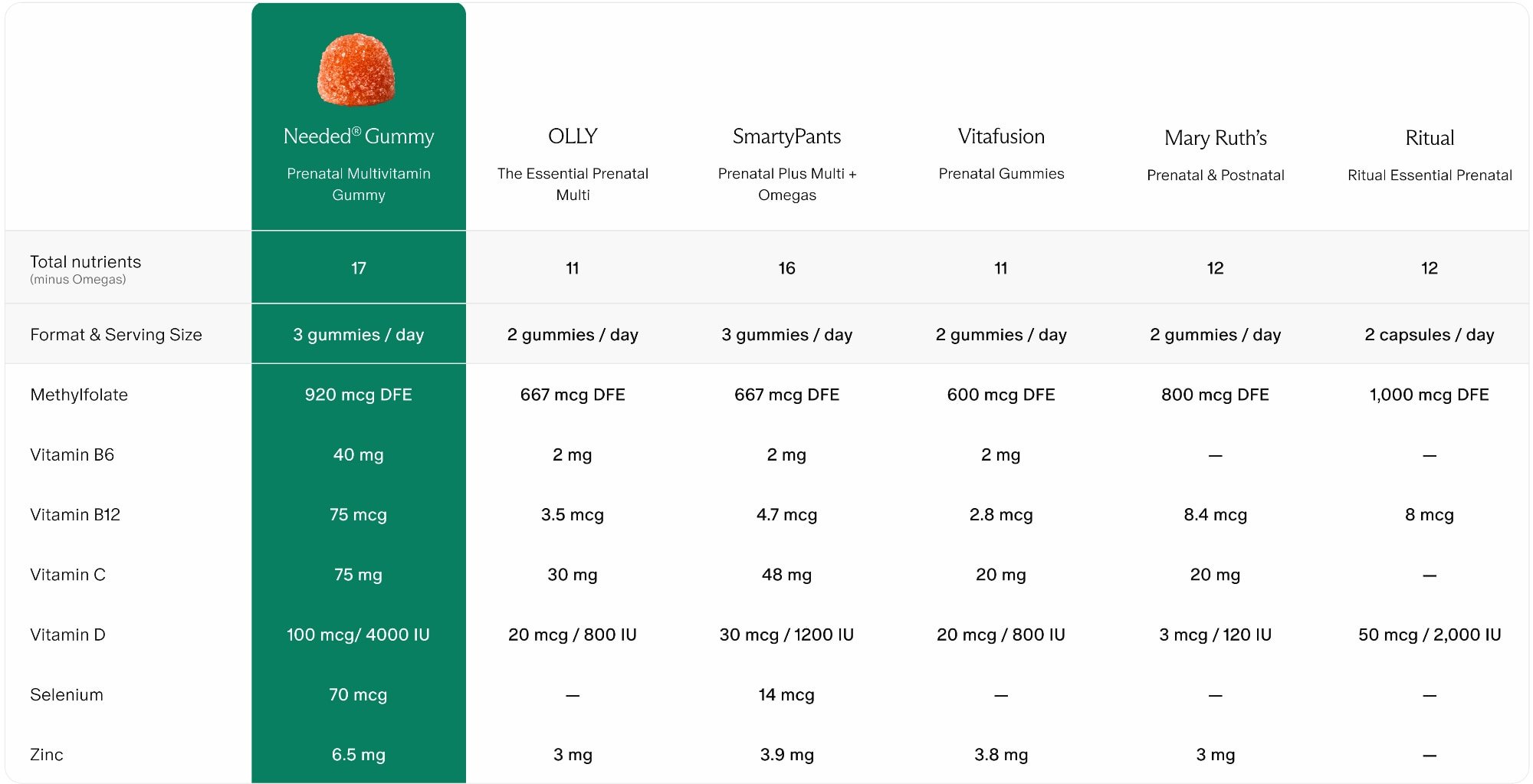
(Labeled daily serving amounts as of May 2026.)
When I look at Needed’s formulation, what stands out is that it addresses several gaps I commonly see in gummy prenatals, particularly vitamin D, B6, B12, selenium, and choline. Three gummies provide 920 mcg DFE of methylfolate, 4,000 IU of vitamin D, 40 mg of vitamin B6, 75 mcg of vitamin B12, 70 mcg of selenium, 6.5 mg of zinc, and 55 mg of choline, along with other vitamins and minerals.
Needed also makes some intentional choices, like leaving iron out so that iron supplementation can be individualized rather than automatically bundled into the prenatal.
For me, the most useful question in choosing a prenatal is simple: Does this particular prenatal provide the nutrients you are looking for, in amounts that make sense for your body, in a format you can actually tolerate?
Why This Prenatal Doesn't Contain Iron
One thing you will notice right away about the Needed Prenatal Gummy is that it does not contain iron. Asking why is a reasonable question, because the recommended intake for iron during pregnancy is 27 mg per day. So why leave it out?
Iron needs can vary considerably from person to person. Your iron status before pregnancy, your blood counts, your ferritin level, your diet, whether you have experienced significant blood loss, and other individual factors all matter when deciding whether and how much supplemental iron you need.
In other words, putting one fixed dose of iron into every prenatal isn't necessarily the most individualized approach.
Further, iron is one of the nutrients that can make a prenatal harder for some people to tolerate. Separating iron from the multivitamin can help make the prenatal easier on the stomach while allowing you and your healthcare provider to decide whether you need additional iron, how much, and in what form.
Why Are Omega-3s Sold Separately
You may also notice that omega-3s aren't packed into the Needed Prenatal Gummy. This is primarily a practical decision.
A meaningful dose of omega-3s takes up considerably more space than many vitamins and minerals, so putting it into a multivitamin can make the serving much larger and harder to take.
That doesn't mean omega-3s aren’t important during pregnancy. It simply means it can make more sense to provide them separately, where the dose and formulation can be designed specifically around the omega-3.
Choline Gummies for Pregnancy
Choline is one of those nutrients that deserves more attention during pregnancy. The recommended intake is 450 mg per day during pregnancy and 550 mg per day while breastfeeding. Choline plays important roles in cell membranes, nervous system function, and early brain development.*
The challenge is that most pregnant women aren't getting enough. NIH data show that pregnant women in the United States generally consume less than the recommended amount, and many prenatal supplements contain little or no choline.
The Needed gummy provides 55 mg of choline, which is a significant contribution, but it doesn't close the entire choline gap. Food can do much of the heavy lifting to help reach your choline needs in pregnancy.
The best dietary choline sources of choline include animal-based products such as meat, poultry, fish, dairy products, and eggs (especially the yolk), as well as cruciferous vegetables like broccoli and kale and certain beans like kidney beans and soybeans.
If you want to close more of the gap through supplementation, Needed also offers a single choline add-on capsule (Prenatal Choline+) you can take alongside the gummy for a total of 555 mg.
What About The Sugar in Prenatal Gummies?
While it would be ideal to have a sugar-free gummy, gummies need a base with enough volume and structure to hold appropriate amounts of multiple nutrients. To put the amount into perspective, Needed’s prenatal gummies have 7 grams of sugar, which is less than the amount of sugar in half of an average banana.
If you’re dealing with pregnancy nausea and have finally found a prenatal that you can tolerate and take consistently, I wouldn’t let the 7 grams of added sugar become another thing to worry about. There are plenty of other places in your day to focus on nourishing yourself, and this is one small piece of the bigger picture.
Pregnancy nutrition doesn’t have to be perfectly optimized at every meal or with every food choice. What matters most is how those choices come together in a dietary pattern over time.
What Actually Helps When You Can't Keep It Down
If your prenatal is turning your stomach, a few simple changes may make it easier to tolerate. For some people, taking it in the evening works better than taking it first thing in the morning.
Taking it with food rather than on an empty stomach can also help, and you may find it easier to split the dose throughout the day rather than taking everything at once. Some people also find cold foods and beverages easier to tolerate than warm or room temperature.
Changing the format is another option. If a capsule isn't working, trying a gummy or another formulation may be enough to get you back into a routine.
As I mentioned before, if you cannot keep fluids or food down, are losing weight, feel dehydrated, or are vomiting frequently, talk with your OB or midwife about treatment options rather than trying to troubleshoot the supplement on your own.
The Prenatal You Can Actually Take
If there is one thing I want you to take away from this, it's that your prenatal doesn't need to be another source of stress. If the bottle has been sitting on your counter because you dread swallowing the capsules, switching to a gummy is a great option to consider.
The "best" prenatal is not necessarily the one with the longest ingredient list. It is the one that fits your nutritional needs and that you can actually take consistently.
For me, that is what makes a well-formulated gummy worth considering, especially during a season of pregnancy when occasional nausea is already making eating and drinking considerably harder than usual.
For more practical nutrition guidance during pregnancy and motherhood, browse the blog, find me on Instagram, or subscribe to my newsletter. And if you're looking for more personalized nutrition support, I'm currently accepting new clients in my virtual private practice and would love to see you.
Thanks for reading!
*These statements have not been evaluated by the Food and Drug Administration. This product is not intended to diagnose, treat, cure, or prevent any disease.
‖Based on a comparison of each brand’s labeled daily serving amounts of vitamins and minerals relative to the pregnancy Recommended Dietary Allowances (RDAs), calculated as an average across those nutrients. As of May 2026.
§4x more nutrition refers to the average amount of vitamins and minerals provided per daily serving, measured relative to pregnancy Recommended Dietary Allowances (RDAs), compared to the average of the leading prenatal capsule brand and Needed’s Prenatal as of May 2026. Brand B: 4x, Brand C: 4x, Brand D: 4x.